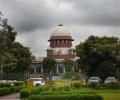
The Supreme Court has asked the CBSE to consider deferring the implementation of its three-language policy for Class 6 students, which mandates two native Indian languages, until the academic session starting 2027. The CBSE stated it would consider the suggestion. The policy, aligned with NEP-2020, makes two native Indian languages compulsory for Class 6 and Class 9, with provisions for foreign languages as additional options and no board exams for the third language in Class 10.

Union Education Minister Pralhad Joshi announced that revised NCERT textbooks for classes 10 to 12 are being prepared in "mission mode," while textbooks for classes 1 to 9 under the new National Curriculum Framework have already been released. He emphasised NCERT's role in building a 'Viksit Bharat' and highlighted the need for curricula to evolve with AI advancements and the importance of India's young population as a global asset.

The Supreme Court has urged the Central Board of Secondary Education (CBSE) to consider exempting Class 6 students from its three-language policy for the current academic year. The policy, which mandates the study of three languages including two native Indian languages, is challenged by petitioners who question CBSE's jurisdiction over classes 6-8. The court emphasized finding a solution that avoids student pressure and suggested a potential deferral for Class 6.

Prime Minister Narendra Modi extended birthday wishes to Union Education Minister Dharmendra Pradhan, commending his significant contributions to the implementation of the National Education Policy. This praise follows the successful re-examination of NEET-UG, despite earlier controversies surrounding paper leaks.

India's student housing shortage is widening, but high land costs, weak rental yields and regulatory hurdles are keeping organised developers away.

'My suggestion to Nandan Nilekani is that it would be worthwhile for him to take a holistic review in a manner in which examination is just one critical component.'
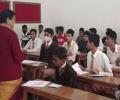
The CBSE has mandated the study of three languages, including at least two native Indian languages, for Class 9 students starting July 1, aligning with the National Education Policy (NEP) 2020 and the National Curriculum Framework for School Education (NCF-SE) 2023.

The Supreme Court has urged the CBSE to reconsider the implementation of its three-language policy for Class 9 students, emphasising that children should not be subjected to undue pressure. The court highlighted concerns about infrastructure, the starting point of the policy, and the definition of 'native' languages.

Mizoram's school education minister inaugurated the northeast region's first 'New Age Tech Skills Centre' at the Government Comprehensive Model School in Aizawl. The centre, established under Bharat Forge Limited's CSR initiative, will offer training in AI, robotics, IoT, 3D printing, CAD, CNC simulation, and drone technology.

The proposed order will state that students currently in Classes 7, 8 and 9 who have opted for two foreign languages under the existing framework will be allowed to continue with the same combination until Class 10.

Student organisations across India celebrated the resignation of Union Education Minister Dharmendra Pradhan, attributing it to their nationwide protests against alleged NEET irregularities. While welcoming the move as a victory, groups like NSUI, AISA, and SFI affirmed their commitment to continue agitations until broader demands for accountability, transparency, and education reforms, including scrapping the NTA and NEP, are met.

Dharmendra Pradhan's political career faced an unexpected jolt as he resigned as Education Minister following nationwide protests over the NEET paper leak, marking a significant departure from the government's initial dismissive response to the agitation.

'Cyberbullying has become extremely worrisome now, with several complaints being received from schools.'

Punjab School Education Board announces integration of Artificial Intelligence as a core component of the school curriculum, with learning outcomes reflected on student certificates.
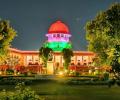
The Supreme Court has directed the Tamil Nadu government to comply with its previous order to identify land for establishing Navodaya Vidyalayas in each district of the state, emphasising cooperative federalism and urging a change in mindset regarding the central government's education policy.

The scenes are same; placards, viral videos, riot, police but the grievances could hardly be more different, notes Abhay Jere, ex-Vice Chairman, AICTE.
"The policy draft has been approved. The ministry has been renamed as education ministry," a senior HRD ministry official said. The existing NEP was framed in 1986 and revised in 1992. A new education policy was part of the Bharatiya Janata Party's manifesto ahead of the 2014 general election.

Congress leader Rahul Gandhi arrived in Chennai on Saturday for the sixth edition of 'Chhatron Ki Goonj,' a youth outreach programme. He is scheduled to meet Chief Minister C Joseph Vijay, marking their first interaction since the formation of the SSJV alliance and TVK joining the INDIA bloc. The visit includes an unscripted interaction with students at Island Grounds, focusing on critical issues, amidst tight security arrangements.
Senior CPI(M) leader V Sivankutty has criticised the Kerala UDF government for allegedly spreading misinformation about the Centre's PM SHRI scheme and attempting to implement it despite earlier opposition. He clarified that the previous LDF government froze the agreement over concerns about the National Education Policy and that funds received were not for PM SHRI. The scheme continues to be a politically contentious issue in the state.

A parliamentary panel flagged staffing shortages at NCERT and CBSE, inadequate education spending, falling enrolment and poor internet connectivity in government schools.

"NEP has given rise to a healthy debate and the more we discuss and debate the more it will benefit the education department. It is palpable that questions will arise on how this huge plan will be implemented. "We all will together do this implementation. Each one of you is directly involved in implementation of the NEP. In terms of political will, I am totally committed and with you," he said.
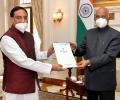
'What can be applicable in Manipur may not make sense in Bengal'
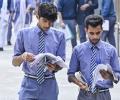
Educationists and parents are raising concerns about the CBSE's implementation of the three-language policy for Class 9, questioning the timing and preparedness of schools.

Prime Minister Narendra Modi has outlined a comprehensive plan to empower India's youth, including training one crore youngsters in artificial intelligence skills and providing free online coaching for competitive examinations, aiming to position them at the forefront of the nation's journey to become a developed nation by 2047.

90 per cent of institutions recorded no improvement in international student metrics, despite government initiatives such as the Study in India programme, UGC regulations on internationalisation, and efforts to attract foreign students.

A national study of top 75 Indian B-schools reveals a significant competency gap in AI skills among management graduates, with industry expectations far exceeding current MBA capabilities. A new framework by AIMS, EPSI, and IMC highlights the urgent need for management education to adapt to an AI-led workplace, emphasizing behavioural competencies alongside data fluency.
NIT Rourkela has announced the launch of four new academic programmes for the 2026-27 session, focusing on emerging technologies such as semiconductors, artificial intelligence, and quantum technologies.

Dedicated Ayush dispensaries increased from 26,130 in 2013-2014 to 37,804 in 2024-2025, while hospitals rose much more slowly, from 3,605 to 3,885.

Delhi Police has registered an FIR against Cockroach Janta Party (CJP) leaders Saurav Das, Ashutosh Ranka, and other members for allegedly trespassing into the Jantar Mantar area, which was recently denotified as a protest site. CJP founder Abhijeet Dipke has condemned the detentions as 'kidnapping' and questioned the legality of preventing lawyers from meeting the detained members.

'Whether they change uniforms or try to rewrite history through education policy, no matter what they do... You have seen what the youth of our country think about this...'

The role of the youth is very important in achieving the goal of 'ease of living' to give a better life to the poor, he told students.

A nationwide survey by a Supreme Court-appointed panel reveals that 15% of higher education students felt overwhelmed or distressed, and 9% experienced suicidal thoughts in the past six months. The findings, part of an upcoming report, highlight deep-rooted social discrimination, academic pressures, and inadequate counselling services contributing to mental health concerns and rising student suicides in Indian Higher Educational Institutions.

A report by Scholars at Risk, 'Free to Think 2026', states that academic freedom in India is "severely restricted" due to increasing government influence over higher education, university governance, and curbs on student expression. India is listed among six countries in this category, with its Academic Freedom Index score sharply declining. The report cites instances of faculty dismissals, event cancellations, and pressure on student protests, highlighting the alleged use of the UGC as a vehicle for state influence.

Job aspirants and guest faculties in Bihar are protesting in Patna, demanding the timely conduct of the BPSC TRE-4 exam, transparency in recruitments, and the resignation of education officials. They also seek implementation of UGC regulations, increased age limits, and regularisation of assistant professor appointments, threatening further agitation if demands are not met.

French President Emmanuel Macron criticised unnamed foreign leaders, including Donald Trump and Benjamin Netanyahu, for making "stupid comments" and exploiting recent domestic unrest in France for their own political campaigns. Speaking in Doha, Macron condemned the use of misinformation and AI-generated content to misrepresent the situation, asserting there was no foreign interference in the events but manipulation of information afterwards. He specifically called out Trump's claims about France being "under siege" and Netanyahu's assertion of an "invasion of extremist Islam."

Congress leader Rahul Gandhi launched a scathing attack on the BJP-RSS, labelling them a "bunch of jokers" with no understanding of India, and criticised Prime Minister Narendra Modi's foreign policy as merely "hugging leaders." He also claimed the RSS has become an instrument of large capital, serving Adani and Ambani, and vowed that the Congress would keep pressure on the government until Modi and Shah resign. The BJP hit back, calling Gandhi immature and out of depth.

A century on, India has adopted the Left's welfare ideas, but not the Left. Why do people borrow the promises, then vote for the temple? questions Binu Alex.

Telangana Chief Minister A Revanth Reddy's planned visit to the United States has been denied political clearance by the Ministry of External Affairs (MEA), citing non-conformity with laid down norms, forcing him to cancel the US leg of his 'TelanganaRising' delegation tour and return to Hyderabad earlier than planned.
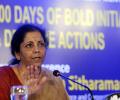
Union Finance Minister Nirmala Sitharaman expressed strong confidence in India achieving over 10 per cent economic growth, advocating for increased technology adoption and innovation. She urged overcoming scepticism and highlighted technology's transformative role in agriculture and public sector reforms, while also launching a new fund and book at an IIT Madras event.
Experts at a national symposium in Shillong discussed the role of Artificial Intelligence in tourism, emphasising that AI should support human judgment, local knowledge, and cultural values rather than replace them. Discussions highlighted the need for robust policies to address ethical concerns, safeguard livelihoods, and preserve cultural heritage while leveraging AI for innovation and sustainability in the tourism sector, particularly in Meghalaya.
